College Grading System Philippines Complete Guide
The college grading system in the Philippines uses a numerical scale from 1.00 to 5.00, where 1.00 is the highest grade (Excellent, 96–100%) and 3.00 is the minimum passing grade (75%).
Most Philippine universities and colleges including UP, UST, PUP, NU, STI, BulSU, and FEU follow this 1.00–5.00 scale under the CHED (Commission on Higher Education) framework, while private institutions like De La Salle University use a 4.0 GPA scale and Ateneo de Manila University uses a letter grade system.
Your overall academic performance is measured through your General Weighted Average (GWA), computed by multiplying each subject’s grade by its credit units and dividing by total units enrolled.
What is the Grading System in College Philippines?
The grading system in Philippine colleges is a standardized method for evaluating student academic performance each semester. The Commission on Higher Education (CHED) provides the general quality framework under the Philippine Qualifications Framework (PQF), but individual Higher Education Institutions (HEIs) have the freedom to adopt their own grading scales within CHED guidelines. Most public universities follow the 1.00 to 5.00 numerical scale. Some private institutions use the 4.0 GPA scale or letter grades.
Unlike a simple average where all subjects carry equal weight, the Philippine college grading system uses weighted grades subjects with more credit units have proportionally greater impact on your overall average. A 5-unit Engineering subject contributes five times more to your GWA than a 1-unit Physical Education class.
1.00 to 5.00 Numerical Scale Most Universities
The most widely used grading system across Philippine higher education. Used by the University of the Philippines (UP), UST, PUP, NU, FEU, STI, BulSU, and the majority of State Universities and Colleges (SUCs) nationwide. Grade 1.00 is the highest mark and 5.00 is failing. The minimum passing grade is 3.00, which corresponds to 75 percent performance.
The critical distinction: lower numbers mean better grades. A grade of 1.00 is outstanding. A grade of 3.00 means you barely passed. A grade of 5.00 means you failed and must retake the subject.
4.0 GPA Scale DLSU and Select Private Schools
De La Salle University (DLSU) and FEU-East Asia College use a 4.0-point scale similar to the American system. In this scale, 4.0 is the highest grade (Excellent) and 0.0 is failing. The scale direction is opposite to the standard Philippine system higher numbers mean better performance. The minimum passing grade at DLSU is 1.0.
Letter Grade System Ateneo de Manila University
Ateneo de Manila University uses letter grades where A corresponds to 92–100 percent and the minimum passing grade is D (60–64 percent). Ateneo calculates a Quality Point Index (QPI) rather than GWA for overall academic standing. The QPI uses a 4.0-point scale: A = 4.0, B = 3.0, C = 2.0, D = 1.0, F = 0.0.
Percentage System PISAY and DepEd SHS
The Philippine Science High School System (PISAY) and DepEd Senior High School (K–12) use direct percentage grades. At PISAY, grades run from 70 to 100 and the minimum passing mark is 75 percent. Grades from 70 to 74 are conditional and require removal examinations. At DepEd SHS, grades run from 60 to 100 and are composed of Written Work (25%), Performance Tasks (50%), and Quarterly Assessment (25%).
Complete College Grading Scale 1.00 to 5.00 Reference Table
Philippine universities on the standard 1.00–5.00 scale follow this CHED-standardized grade equivalence table. The descriptions, percentage ranges, and honor standings below apply to most public universities including UP, UST, PUP, NU, FEU, and all State Universities and Colleges (SUCs) nationwide.
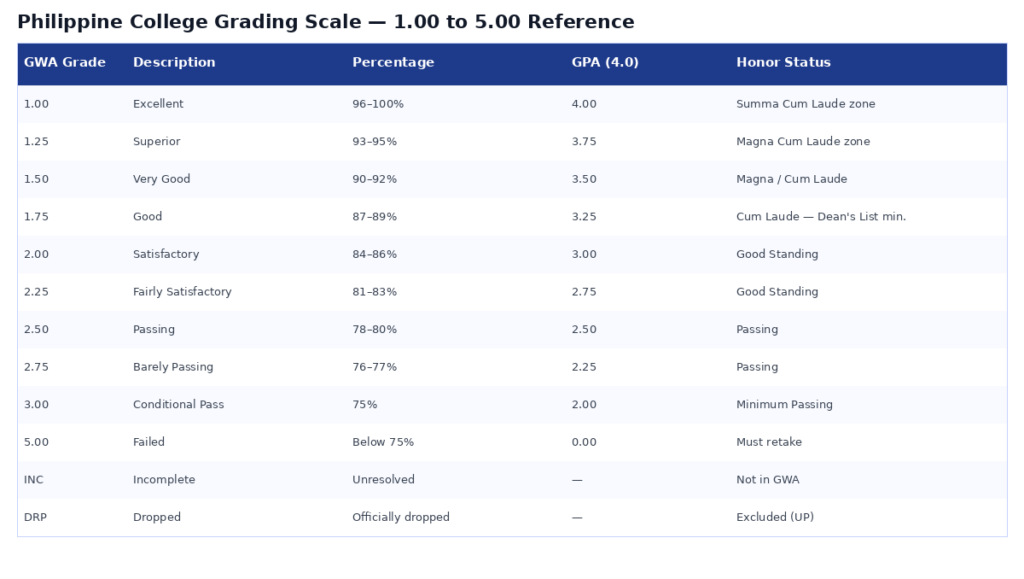
| GWA Grade | Description | Percentage | GPA (4.0) | Honor Status |
| 1.00 | Excellent | 96–100% | 4.00 | Summa Cum Laude zone |
| 1.25 | Superior | 93–95% | 3.75 | Magna Cum Laude zone |
| 1.50 | Very Good | 90–92% | 3.50 | Magna / Cum Laude range |
| 1.75 | Good | 87–89% | 3.25 | Cum Laude Dean’s List min. |
| 2.00 | Satisfactory | 84–86% | 3.00 | Good Standing |
| 2.25 | Fairly Satisfactory | 81–83% | 2.75 | Good Standing |
| 2.50 | Passing | 78–80% | 2.50 | Passing |
| 2.75 | Barely Passing | 76–77% | 2.25 | Passing |
| 3.00 | Conditional Pass | 75% | 2.00 | Minimum Passing Grade |
| 5.00 | Failed | Below 75% | 0.00 | Must retake subject |
| INC | Incomplete | Unresolved | Not in GWA until resolved | |
| DRP | Dropped | Officially dropped | Excluded from GWA (UP) | |
| OD / FA | Failed due to absences | Below attendance req. | Counted as failing in GWA |
Note: Only the standard grade points shown above appear on official Philippine grade slips. Intermediate values like 1.33 or 2.10 are not used as final grades in the standard Philippine system.
How is the Grading System in College Computed?
Philippine college grades are computed in two stages: the individual subject grade and the General Weighted Average (GWA) across all subjects. Understanding both is essential for tracking academic standing and planning for Dean’s List or Latin honor eligibility.
Prelim, Midterm, and Finals Grade Computation
Most Philippine universities compute the final subject grade using three periodic grades:
- Preliminary Grade (Prelim) typically 30% of the final grade
- Midterm Grade typically 30% of the final grade
- Final Grade (Finals) typically 40% of the final grade
Each periodic grade is computed from Class Standing (CS) and the Periodic Examination. Class Standing covers quizzes, recitation, projects, and homework. Always verify your specific school’s grading policy with your professor or registrar.
GWA Formula General Weighted Average Computation
GWA = Σ(Subject Grade × Credit Units) ÷ Total Units Enrolled
Multiply each subject’s final grade by its credit units. Add all the products. Divide by total units enrolled that semester.
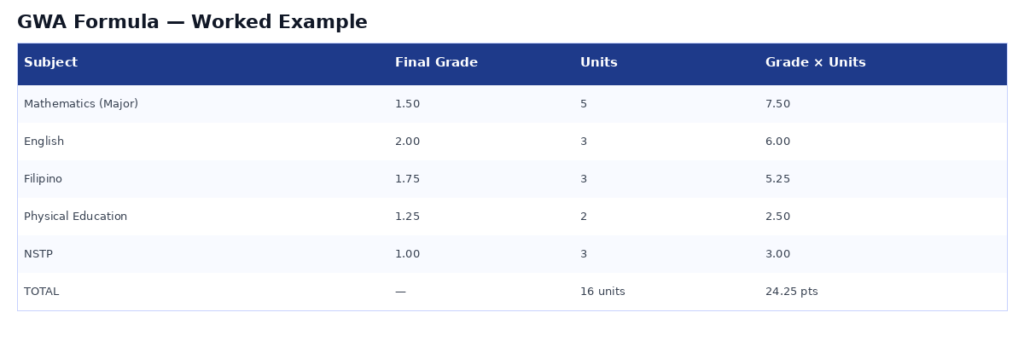
Figure 2: GWA Formula Worked Example (GWA = 24.25 ÷ 16 = 1.52)
| Subject | Final Grade | Units | Grade × Units |
| Mathematics (Major) | 1.50 | 5 | 7.50 |
| English | 2.00 | 3 | 6.00 |
| Filipino | 1.75 | 3 | 5.25 |
| Physical Education | 1.25 | 2 | 2.50 |
| NSTP | 1.00 | 3 | 3.00 |
| TOTAL | 16 units | 24.25 pts |
GWA = 24.25 ÷ 16 = 1.52 (Magna Cum Laude range)
Mathematics with 5 units contributed 7.50 quality points nearly a third of the entire GWA result from one subject. This is why improving a grade in a high-unit major subject has dramatically greater GWA impact than improving a 1-unit elective.Use our free GWA Calculator to compute your GWA instantly.
Transmutation Formula Philippines
Many Philippine universities use a transmutation formula to convert raw percentage scores into numerical grades on the 1.00–5.00 scale:
Transmuted Grade = 1 + 4 × [(100 − Raw Score) ÷ (100 − Passing Score)]
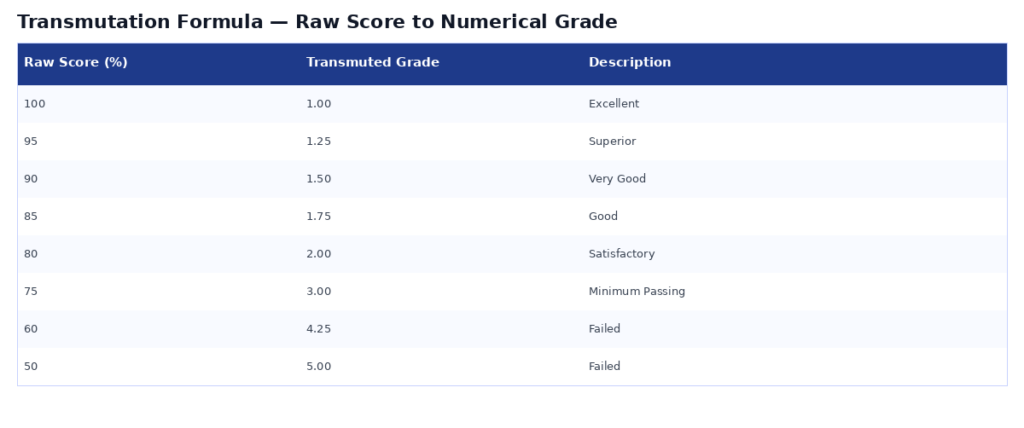
Using 75 as the passing score: a raw score of 100 becomes 1.00 (Excellent). A raw score of 75 becomes 3.00 (minimum passing). A raw score of 50 becomes 5.00 (Failed). Bulacan State University (BulSU) eliminated transmutation through zero-based grading. Some universities use 60 percent as the passing score, which changes the output always verify with your institution.
Grading System by University UP, UST, PUP, NU, Mapua, Ateneo, DLSU
While most Philippine universities share the same base 1.00–5.00 scale, each institution applies specific rules for Dean’s List recognition, honor scholarships, conditional grades, and academic standing.
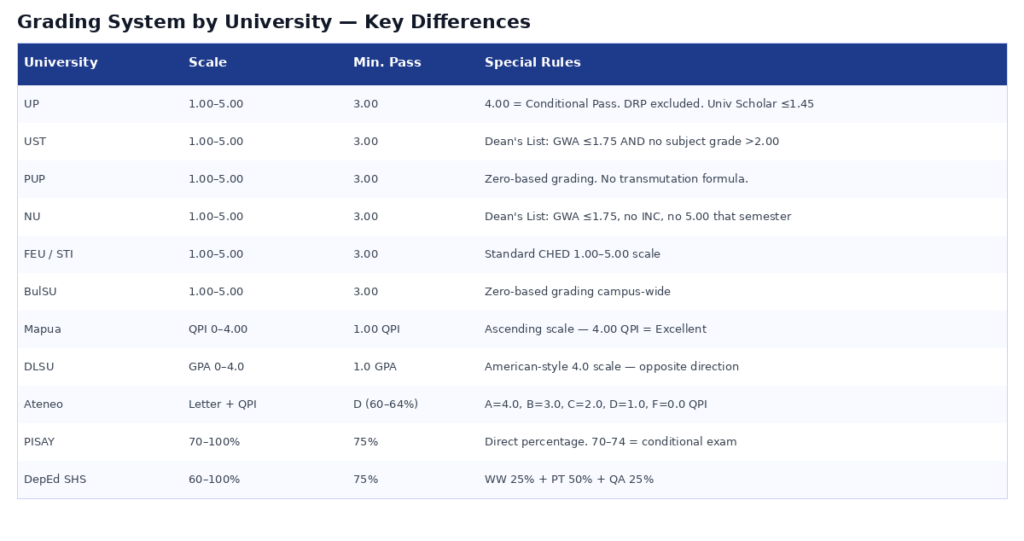
| University | Scale | Min. Pass | Key Special Rules |
| UP | 1.00–5.00 | 3.00 | 4.00 = Conditional Pass (removal exam). DRP excluded from GWA. University Scholar: GWA ≤1.45. |
| UST | 1.00–5.00 | 3.00 | Dean’s List: GWA ≤1.75 AND no subject grade above 2.00. Both conditions required. |
| PUP | 1.00–5.00 | 3.00 | Zero-based grading. No transmutation formula campus-wide. |
| NU | 1.00–5.00 | 3.00 | Dean’s List: GWA ≤1.75, no INC, no 5.00 in that semester. |
| FEU / STI | 1.00–5.00 | 3.00 | Standard CHED 1.00–5.00 scale with standard percentage equivalents. |
| BulSU | 1.00–5.00 | 3.00 | Zero-based grading raw scores mapped directly without transmutation. |
| ISU | 1.00–5.00 | 3.00 | Standard 1.00–5.00 scale used across all ISU campuses. |
| Mapua | QPI 0–4.00 | 1.00 (QPI) | Ascending scale 4.00 QPI = Excellent. Opposite of standard GWA. |
| DLSU | GPA 0–4.0 | 1.0 (GPA) | American-style 4.0 scale. Higher = better. Opposite of standard Philippine GWA. |
| Ateneo | Letter + QPI | D (60–64%) | A=4.0, B=3.0, C=2.0, D=1.0, F=0.0 QPI. No standard GWA used. |
| PISAY | 70–100% | 75% | Direct percentage. Grades 70–74 = conditional. Removal exam required. |
| DepEd SHS | 60–100% | 75% | Written Work 25% + Performance Tasks 50% + Quarterly Assessment 25%. |
Passing Grade in College Philippines
What is the Minimum Passing Grade?
The minimum passing grade at most Philippine universities using the 1.00–5.00 scale is 3.00, which corresponds to 75 percent. A grade numerically above 3.00 meaning 4.00 (conditional at UP) or 5.00 (failing at all universities) represents failing or conditional standing.
| Institution Type | Minimum Passing Grade | Percentage |
| Most public universities (UP, PUP, NU, FEU, SUCs) | 3.00 | 75% |
| UST | 3.00 | 75% |
| De La Salle University (DLSU) | 1.0 (on 4.0 GPA scale) | Approx. 65% |
| Ateneo de Manila University | D | 60–64% |
| PISAY | 75 (percentage) | 75% |
| DepEd SHS (K–12) | 75 (percentage) | 75% |
INC, DRP, OD Special Grade Notations Explained
Philippine colleges use several special grade notations that affect GWA computation differently:
- Student did not complete a major requirement. NOT included in GWA until resolved. Must be completed within one academic year. If unresolved, automatically converts to 5.00 (Failed) and is permanently included in GWA.INC (Incomplete):
- Subject was officially dropped before the deadline. Completely excluded from GWA. Used primarily in the UP System. Always preferable to failing.DRP (Dropped):
- Student exceeded allowed absences. Recorded as a failing grade and permanently included in GWA. Cannot be removed from transcript.OD / FA (Failed due to absences):
- Used by some universities. Treatment varies some exclude from GWA, others count as failing. Verify with your registrar.W (Withdrawn):
Latin Honors and GWA Requirements in Philippine Colleges
Latin honors at graduation are determined by the student’s cumulative GWA across the entire college record from first year through the final semester. A single failing grade of 5.00 anywhere on the complete transcript permanently disqualifies from all Latin honors, regardless of all subsequent performance.
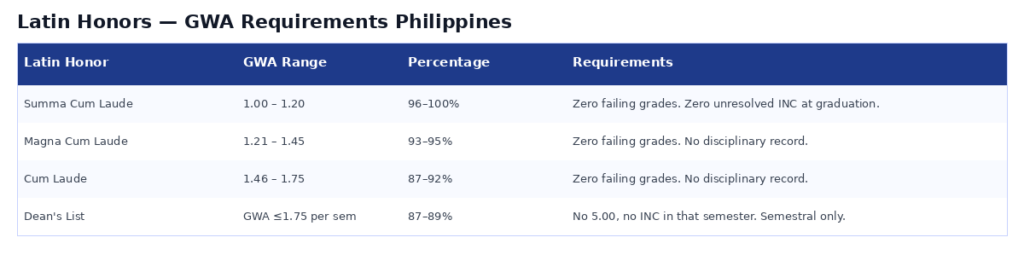
Figure 5: Latin Honors GWA Requirements and Percentage Equivalents
| Latin Honor | Cumulative GWA | Percentage | Key Requirements |
| Summa Cum Laude | 1.00 – 1.20 | 96–100% | Zero failing grades on entire transcript. Zero unresolved INC at graduation. No disciplinary record. |
| Magna Cum Laude | 1.21 – 1.45 | 93–95% | Zero failing grades. Zero unresolved INC. No disciplinary record. |
| Cum Laude | 1.46 – 1.75 | 87–92% | Zero failing grades. Zero unresolved INC. No disciplinary record. |
| Dean’s List | GWA ≤1.75 per semester | 87–89% | No 5.00, no INC in that semester only. Semestral award. |
Note: GWA thresholds for Latin honors vary slightly between universities. Always verify your specific institution’s graduation requirements with the Office of the Registrar.
CHED Policy on the Grading System in the Philippines
The Commission on Higher Education (CHED) is the governing body for tertiary education in the Philippines under Republic Act 7722. CHED does not mandate a single uniform grading system across all universities. Under the Philippine Qualifications Framework (PQF), Higher Education Institutions may design their own scales within CHED quality standards.
The 1.00–5.00 numerical scale is the de facto standard adopted by most public HEIs. CHED Memorandum Order (CMO) No. 46, s. 2012 established Outcomes-Based Education (OBE) across Philippine higher education, shifting focus toward competency-based assessment though the numerical scale remains unchanged at most institutions.
For students transferring between universities or applying to graduate programs abroad, CHED does not automatically convert grades between institutional scales. A certified grade conversion from the registrar is required. For international applications, recognized credential evaluation services such as WES (World Education Services) or ECE (Educational Credential Evaluators) provide official Philippine-to-foreign grade conversions.
Frequently Asked Questions College Grading System Philippines
What is the grading system used in college in the Philippines?
Most Philippine colleges use a numerical 1.00 to 5.00 grading scale where 1.00 is the highest grade (Excellent, 96–100%) and 3.00 is the minimum passing grade (75%). The scale is used by UP, UST, PUP, NU, FEU, STI, BulSU, and most state universities. DLSU uses a 4.0 GPA scale and Ateneo uses a letter grade system. CHED does not mandate a single unified system each university sets its own scale within CHED guidelines.
What is the passing grade in college Philippines?
The minimum passing grade at most Philippine universities on the 1.00–5.00 scale is 3.00, which equals 75 percent. A grade numerically above 3.00 such as 4.00 (conditional at UP) or 5.00 represents failing or conditional standing. At DLSU, passing is 1.0 on the 4.0 GPA scale. At Ateneo, passing is grade D (60–64%). At PISAY and DepEd SHS, passing is 75 percent.
Is 3.0 a good grade in the Philippines?
No. A grade of 3.00 is the minimum passing grade at most Philippine universities, equivalent to 75 percent. It is not competitive for scholarship eligibility, Dean’s List recognition, or Latin honors. Students aiming for academic distinctions should target a semestral GWA of 1.75 or better for Dean’s List and a cumulative GWA of 1.75 or better for Cum Laude graduation honors.
What does 1.00 mean in the Philippine grading system?
A grade of 1.00 is the highest possible mark in the Philippine 1.00–5.00 system, equivalent to Excellent performance at 96–100 percent. On the US GPA scale, a GWA of 1.00 converts to 4.00 GPA. A student with consistent 1.00 grades is in the Summa Cum Laude range and eligible for the University Scholar distinction at UP (requires GWA of 1.45 or better with no grade below 3.00).
What does 5.00 mean in Philippine college grading?
A grade of 5.00 is a failing grade equivalent to below 75 percent. The subject must be retaken to earn credit. A single 5.00 grade anywhere on the complete college transcript permanently disqualifies a student from all Latin honors at graduation, regardless of all other grades.
What is INC in the Philippine college grading system?
INC stands for Incomplete. It is assigned when a student did not complete a major requirement but met attendance. An INC is not included in GWA until resolved. Most universities give one academic year to complete requirements. If unresolved, INC automatically becomes 5.00 (Failed) and is permanently included in GWA.
Does CHED set a standard grading system for all Philippine colleges?
No. CHED does not mandate a single unified grading scale. Universities may adopt their own grading systems as long as they are fair, transparent, and aligned with CHED quality standards and the Philippine Qualifications Framework. The 1.00–5.00 scale is the de facto standard for public universities but is not legally required for all institutions.
How does the Philippine grading system compare to the US GPA?
Philippine GWA and US GPA use opposite directions. In the Philippines, lower numbers mean better performance (1.00 = best). In the US, higher numbers mean better performance (4.0 = best). The conversion formula is: GPA = 5.0 − GWA. A Philippine GWA of 1.75 converts to approximately US GPA 3.25.For the complete conversion table, see our guide on GWA to GPA conversion Philippines
What GWA is needed for Cum Laude in the Philippines?
Cum Laude requires a cumulative GWA of 1.46 to 1.75 (87–92%) with zero failing grades. Magna Cum Laude requires GWA 1.21 to 1.45 (93–95%). Summa Cum Laude requires GWA 1.00 to 1.20 (96–100%). All Latin honors require zero unresolved INC grades at graduation and no academic disciplinary record.
What is the transmutation formula used in Philippine colleges?
Transmuted Grade = 1 + 4 × [(100 − Raw Score) ÷ (100 − Passing Score)]. Using 75 as passing: raw score of 100 becomes 1.00, raw score of 75 becomes 3.00, raw score of 50 becomes 5.00. Some universities use 60 as passing score. BulSU eliminated transmutation through zero-based grading.