How to Compute Grades in College Philippines Complete Step-by-Step Guide 2026
You are sitting at your desk, grade slip in your hand, staring at a row of numbers you do not fully understand. You know you passed most of your subjects. But you have no idea what your GWA actually is whether you made the Dean’s List, whether your scholarship is safe, or whether you are closer to that Latin honor than you think.
Every Filipino college student has been in that exact moment.
This guide ends the confusion. You will learn exactly how to compute your grades in college from a single subject grade to your full semestral GWA with real examples, real numbers, and a method that works for every Philippine university.
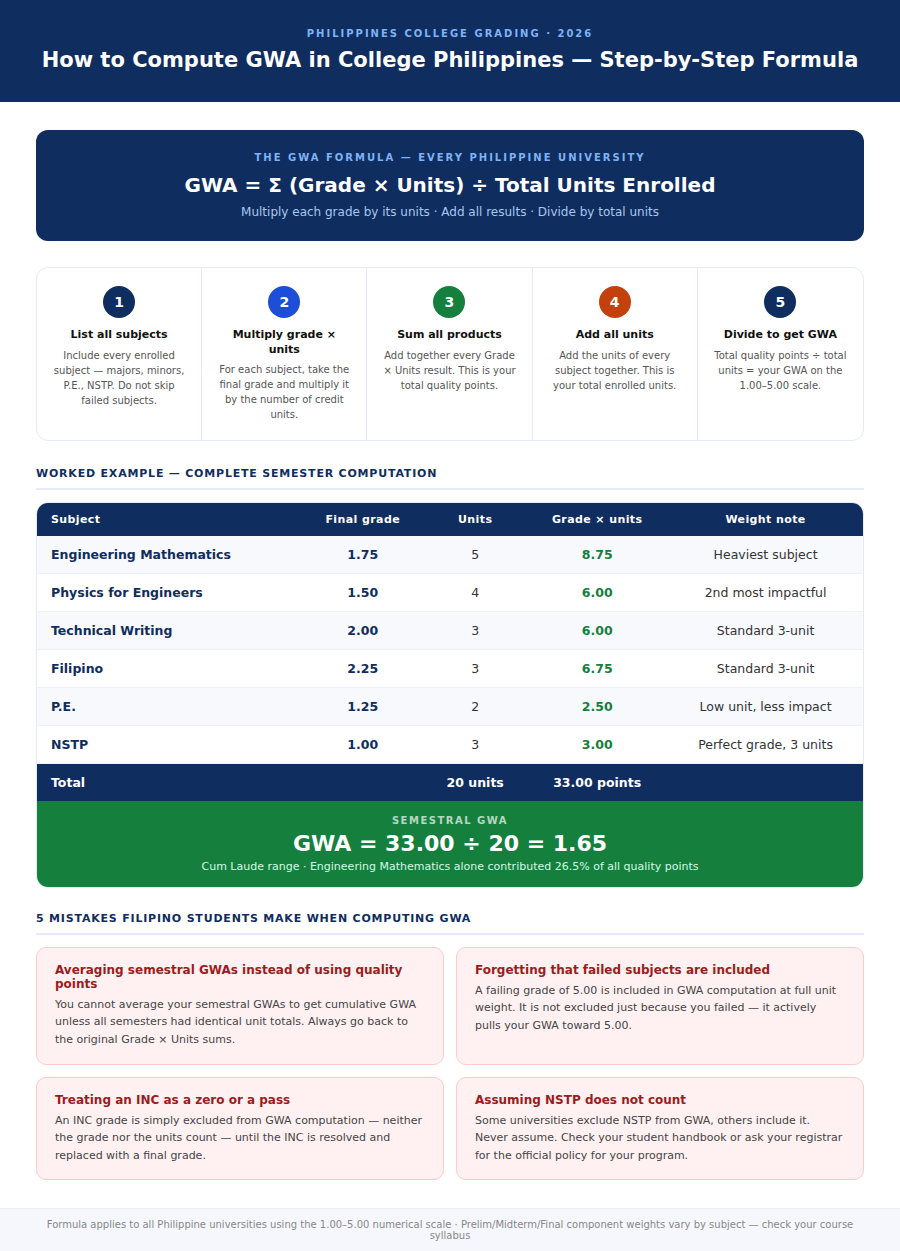
The Basic Formula for Computing Grades in College Philippines
Before anything else, you need to understand one formula. Everything else in this guide builds on it.
GWA = Sum of (Final Grade × Units per subject) ÷ Total Number of Units
That is it. That is the entire mathematical foundation of the Philippine college grading system.
In plain language: you multiply each subject’s grade by the number of units it carries. You add all those results together. Then you divide by the total units you are enrolled in. The result is your General Weighted Average.
The reason this is called a weighted average not a simple average is because subjects with more units pull harder on your final number. A 5-unit Engineering subject matters five times more than a 1-unit NSTP class. Understanding this one fact is the single most important insight for any Filipino student who wants to manage their GWA strategically.f you are still unclear on the full GWA meaning what General, Weighted, and Average each mean in practice — that guide gives you the complete foundation before you start computing
Step-by-Step: How to Compute Your GWA in College
Step 1 List all your subjects with their final grades and units
Open your grade slip or check your university’s online portal. Write down every subject you enrolled in for the semester, including the final grade you received and the number of credit units that subject carries.
Do not skip any subject not even P.E., not even NSTP, not even subjects you failed. All of them count in GWA computation unless your university has a specific policy excluding certain non-academic courses. When in doubt, include everything and confirm with your registrar later.
Step 2 Multiply each subject’s grade by its units
For each subject on your list, take the final grade and multiply it by the number of units.
| Subject | Final Grade | Units | Grade × Units |
|---|---|---|---|
| Engineering Mathematics | 1.75 | 5 | 8.75 |
| Physics for Engineers | 1.50 | 4 | 6.00 |
| Technical Writing | 2.00 | 3 | 6.00 |
| Filipino | 2.25 | 3 | 6.75 |
| P.E. | 1.25 | 2 | 2.50 |
| NSTP | 1.00 | 3 | 3.00 |
Step 3 — Add up all the Grade × Units results
Add together every number in the Grade × Units column.
8.75 + 6.00 + 6.00 + 6.75 + 2.50 + 3.00 = 33.00 total quality points
Step 4 — Add up all your units
Add together every number in the Units column.
5 + 4 + 3 + 3 + 2 + 3 = 20 total units
Step 5 — Divide total quality points by total units
GWA = 33.00 ÷ 20 = 1.65
This student’s semestral GWA is 1.65 which falls within the Cum Laude range at most Philippine universities.For a complete reference on what every grade from 1.00 to 5.00 means including special notations like INC, DRP, and FDA and how they affect computation see our guide on grades in college Philippines
How to Compute Prelim, Midterm, and Final Grades
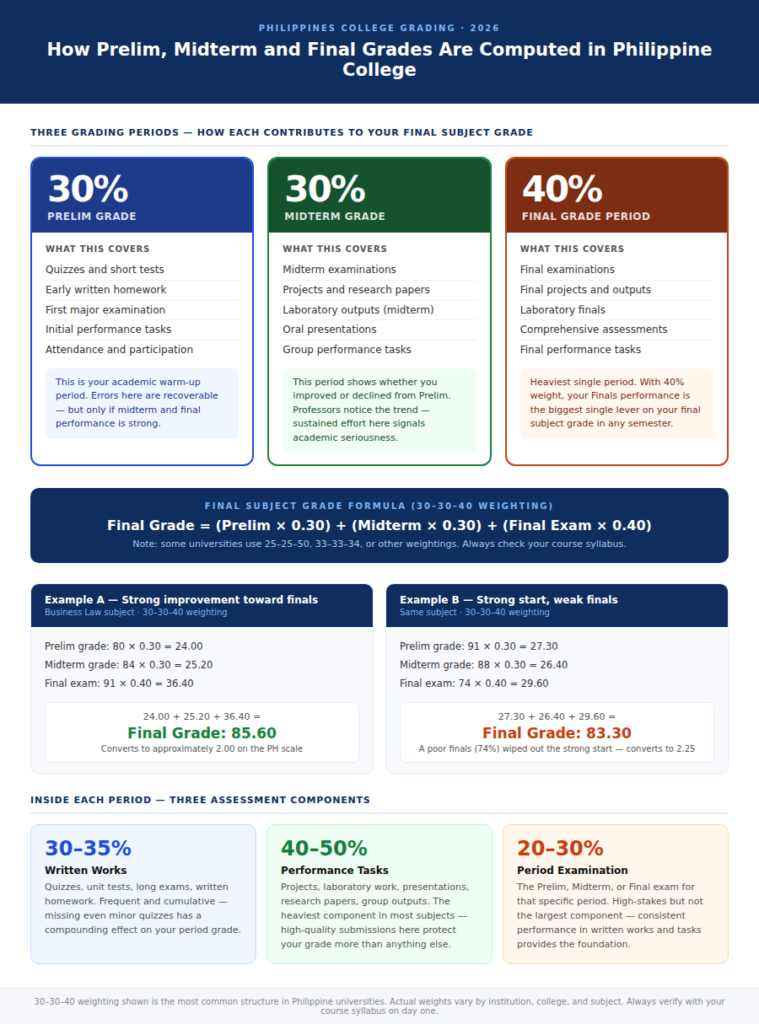
Understanding how to compute GWA is only half the picture. Before your GWA can be computed, each individual subject grade must be computed from the components your professor uses throughout the semester. Most Philippine colleges use three grading periods Prelim, Midterm, and Final and your Final Grade in each subject comes from combining these.
How Prelim, Midterm, and Final Grades Are Combined
Most Philippine universities compute the Final Grade in each subject using weighted averages of the three grading periods. A common weighting used by many schools is:
- Prelim Grade: 30 percent of the Final Grade
- Midterm Grade: 30 percent of the Final Grade
- Final Exam Grade: 40 percent of the Final Grade
Final Grade = (Prelim × 0.30) + (Midterm × 0.30) + (Finals × 0.40)
Worked Example Computing a Single Subject’s Final Grade
Imagine you are enrolled in Business Law. Your performance across the three periods is:
- Prelim Grade: 84
- Midterm Grade: 88
- Final Exam Grade: 91
Final Grade = (84 × 0.30) + (88 × 0.30) + (91 × 0.40) Final Grade = 25.20 + 26.40 + 36.40 = 88.00
Your final grade in Business Law is 88 percent, which on the standard Philippine 1.00 to 5.00 scale converts to approximately 1.75.
Note: not all universities use the 30-30-40 weighting. Some use 25-25-50, some use 33-33-34, and professional programs often have different structures. Always check your course syllabus on the first day of class for the exact weighting your professor uses.
How Each Grading Period Is Computed
Within each grading period, your grade typically comes from three types of assessment. Here is how most Philippine universities structure it:
Written Works (30–35%) quizzes, unit tests, long exams, written homework, and essays. These are your most frequent assessments throughout the period.
Performance Tasks (40–50%) projects, laboratory experiments, research papers, oral presentations, group outputs, recitations, and demonstrations. This is typically the heaviest component and where consistent effort matters most.
Period Examination (20–30%) the Prelim, Midterm, or Final exam for that specific grading period. This is a single high-stakes assessment, but under most structures it is not the largest component of your grade.
Period Grade = (Written Works score × weight) + (Performance Tasks score × weight) + (Exam score × weight)
How to Compute GWA for a Full Academic Year (Cumulative GWA)
Your cumulative GWA covers your entire college career every subject from every semester since your first year. This is the GWA that appears on your Transcript of Records (TOR) and the one used to determine your Latin honor eligibility at graduation.
To compute your cumulative GWA, you use the exact same formula. The only difference is that you include all subjects from all semesters not just the current one.
Cumulative GWA Computation Example
A student has completed three semesters:
Semester 1: 20 units, total quality points 36.00 → Semestral GWA 1.80 Semester 2: 22 units, total quality points 38.50 → Semestral GWA 1.75 Semester 3: 21 units, total quality points 35.70 → Semestral GWA 1.70
To compute the cumulative GWA, you do NOT average the three semestral GWAs. You must use the original totals:
Total quality points = 36.00 + 38.50 + 35.70 = 110.20 Total units = 20 + 22 + 21 = 63 units
Cumulative GWA = 110.20 ÷ 63 = 1.75
This is an important point many students get wrong. Averaging your semestral GWAs (1.80 + 1.75 + 1.70 ÷ 3 = 1.75) gives the same result in this case only because the unit counts are similar. If your semesters had different unit totals, averaging the semestral GWAs would give you the wrong cumulative number. Always go back to the original quality points and units.If your cumulative GWA is around 2.50, our dedicated guide on 2.50 grade equivalent Philippines shows exactly what that means for your scholarship, Dean’s List eligibility, and the grades you need to improve it.
How to Compute GWA at Specific Philippine Universities
How to Compute GWA at the University of the Philippines (UP)
The University of the Philippines uses the standard 1.00 to 5.00 numerical scale. The computation method is identical to the standard formula above. UP uses the same GWA = Σ(Grade × Units) ÷ Total Units formula.
One important UP-specific detail: the grade of 4.00 at UP represents a conditional pass not a failing grade. A student who receives a 4.00 has one year to take a removal examination and replace it with a passing grade. If not removed within one year, the 4.00 automatically becomes a permanent 5.00 (failing) on the transcript. For GWA computation before removal, the 4.00 is included at face value.For students applying internationally, this computed GWA will need to be expressed as a GPA equivalent our guide on GPA vs GWA Philippines covers the conversion formula and certified evaluation options
UP also uses a DRP (Dropped) notation for subjects officially withdrawn by the student with faculty and registrar approval. DRP grades are not counted in GWA computation.
UP scholarships including UP College Scholarship have specific GWA maintenance requirements. UP College Scholars generally must maintain a GWA of 2.00 or better with no failing grades to retain their scholarship. Confirm current requirements with your college scholarship committee.
How to Compute GWA at National University (NU)
NU uses the standard Philippine 1.00 to 5.00 grading scale. The GWA computation formula is the same. NU’s Dean’s List recognition requires a semestral GWA of 1.75 or better with no failing or incomplete grades during that specific term.
How to Compute GWA at the University of Santo Tomas (UST)
UST uses the standard 1.00 to 5.00 scale. The computation is identical. For Thomasian Dean’s List recognition, students must achieve a semestral GWA of 1.75 with no grade lower than 2.00 in any single subject during that term.
How to Compute GWA at Philippine Science High School (PISAY)
PISAY uses a percentage-based system from 70 to 100, not the standard college 1.00 to 5.00 numerical scale. The minimum passing grade at PISAY is 75 percent. The GWA formula structure remains the same each subject’s percentage grade is multiplied by its unit weight, the results are summed, and the total is divided by the sum of all unit weights.
How to Compute GWA for Senior High School (DepEd)
In Senior High School under the DepEd K to 12 curriculum, grades are expressed as percentages from 0 to 100. The minimum passing grade is 75 percent. Each subject’s final grade is computed from Written Works, Performance Tasks, and Quarterly Assessment, with percentage weights that vary by learning area.
The GWA in SHS is the average of all your final subject grades. Because most SHS subjects are treated as carrying equal weight in the overall computation, SHS GWA functions more like a simple average than the heavily weighted system used in college.
How to Compute What Grade You Need to Reach Your Target GWA
This is perhaps the most practically useful computation every Filipino student should know not just how to compute what your GWA is, but how to compute what grades you need to achieve the GWA you want.
The formula works in reverse. If you know how many units you have already completed and what your current cumulative quality points are, you can calculate what grades you need in your remaining subjects to hit a target GWA.
Target GWA Reverse Computation
Scenario: A student has completed 40 units with a cumulative GWA of 2.00. They are enrolled in 20 more units this semester. They want to graduate with a cumulative GWA of 1.75 for Cum Laude eligibility.
Step 1 Calculate existing quality points: 40 units × 2.00 = 80.00 existing quality points
Step 2 Calculate total quality points needed at target GWA: (40 + 20) units × 1.75 target GWA = 105.00 total quality points needed
Step 3 Calculate quality points needed from remaining subjects: 105.00 − 80.00 = 25.00 quality points needed from 20 remaining units
Step 4 Calculate average grade needed across remaining units: 25.00 ÷ 20 units = 1.25 average grade needed
This student needs to average a grade of 1.25 across all their remaining subjects this semester to reach a cumulative GWA of 1.75. That is a very high bar Magna Cum Laude level performance which tells this student they need to be realistic about whether the target is achievable given their current standing.
Use our GWA Calculator at the top of this page to run these calculations instantly without doing the math by hand.
What Counts and What Does Not Count in GWA Computation
Understanding exactly which grades are included in your GWA computation prevents surprises when you check your official standing with the registrar.
Grades that COUNT in GWA computation:
All subjects you enrolled in and received a final grade for including subjects where you received a failing grade of 5.00. Failed subjects are included at full weight, which is why a single failed subject in a high-unit course can significantly damage your GWA.
Retaken subjects count in GWA computation according to your university’s specific policy. Some universities replace the original grade with the new grade (grade replacement). Others average the two grades. Still others retain both grades in the record but compute GWA using only the most recent grade. Confirm your university’s policy before assuming how a retaken subject will affect your cumulative GWA.
Grades that DO NOT count in GWA computation:
INC (Incomplete) grades are not computed until resolved. An INC remains outside GWA computation until the student completes the missing requirements and the professor submits a final grade. Most universities give students one academic year to resolve an INC before it automatically converts to a failing grade.
DRP or W (Dropped/Withdrawn) grades are not counted. Subjects officially withdrawn through proper university channels before the deadline do not factor into GWA. However, late withdrawals beyond the official deadline may receive a grade of 5.00 at some universities, which would count.
Non-credit subjects and audit courses are not counted. If your university designates certain courses as non credit, they do not affect GWA.
The Most Common Mistakes Filipino Students Make When Computing Their GWA
Mistake 1 Averaging semestral GWAs instead of going back to quality points
As shown in the cumulative computation example earlier, you cannot simply average your semestral GWAs to get your cumulative GWA unless all semesters had identical total units. Always recompute from the original Grade × Units products and total units.
Mistake 2 Forgetting that failed subjects are included
Many students assume that failed subjects are automatically excluded from GWA computation. They are not. A 5.00 in a 5-unit subject adds 25.00 quality points at the worst possible grade level and dramatically pulls your GWA down. This is why recovering from a failed subject is so critical.
Mistake 3 Using the wrong unit count for a subject
Some subjects have different unit counts than you expect particularly laboratory classes, which often have separate lecture and laboratory components counted as distinct subjects with different unit values. Always check your enrollment form or official grade slip for the exact unit count.
Mistake 4 Treating INC as a passing grade in the computation
An INC grade does not act as a passing grade or a neutral value in GWA computation it is simply excluded until resolved. But the exclusion of those units from your total can affect your cumulative GWA in ways that are not always obvious.
Mistake 5 Not checking whether NSTP and P.E. are included
Some Philippine universities exclude NSTP from GWA computation. Others include it. P.E. policies vary similarly. Check your student handbook or ask your registrar directly. Including or excluding a 3-unit NSTP subject with a grade of 1.00 can make a meaningful difference in your GWA.
Frequently Asked Questions About Computing Grades in College Philippines
What is the formula for computing GWA in college?
The formula is GWA = Sum of (Grade × Units for each subject) ÷ Total Number of Units. Multiply each subject’s final grade by its unit count, add all the results together, then divide by the sum of all units. This formula is used by all Philippine universities that follow the 1.00 to 5.00 numerical grading scale.
How do I compute my GWA if I have an INC grade?
An INC (Incomplete) grade is not included in GWA computation until resolved. For the purpose of computing your current GWA, exclude the subject with an INC grade both the grade and the units. Once the INC is resolved and replaced with a final grade, include it in all future computations.
Is a failing grade included in GWA computation in the Philippines?
Yes. A failing grade of 5.00 is included in GWA computation just like any other grade. Because it is the highest numerical value on the scale (remember: lower is better in the Philippine system), a failed subject pulls your GWA up toward 5.00, which represents worse performance. This is one of the most damaging things that can happen to your cumulative GWA and why academic advisers stress the importance of avoiding failing grades even if it means withdrawing from a subject before the drop deadline.
How do I compute my GWA for the purpose of Dean’s List?
For Dean’s List eligibility, most Philippine universities use your semestral GWA meaning only the grades from the current semester. Compute your GWA using only the subjects and final grades from the specific semester in question. The typical threshold is a semestral GWA of 1.75 or better with no failing grades, though specific requirements vary by university.
Can I still raise my cumulative GWA after a bad semester?
Yes. Your cumulative GWA is always recomputed from all grades across all semesters combined. A consistently strong performance over multiple future semesters can pull your cumulative GWA up significantly. However, recovery from a very low cumulative GWA takes many semesters of high performance because your poor grades remain in the computation. The more total units you accumulate with strong grades, the more your early weak semesters get diluted in the overall average.
How do I compute the grade I need in my remaining subjects to qualify for Latin honors?
Use the reverse computation method. Multiply your target cumulative GWA by your total units including remaining ones. Subtract your existing total quality points from that target. Divide the difference by your remaining units. The result is the average grade you need across your remaining subjects to hit your target. Use our free GWA Calculator at the top of this page to run this instantly.
Does the university compute GWA the same way for all programs?
The GWA formula itself is the same GWA = Σ(Grade × Units) ÷ Total Units across all programs. What varies by program and university is the grading scale, the passing grade, and the specific Latin honor cutoffs. Engineering programs, nursing programs, and board-regulated professional programs in the Philippines may also have additional GWA requirements for retention or graduation beyond the standard university minimums.
How does computing GWA in college differ from Senior High School?
In college, the GWA is truly weighted subjects with more units have more influence. In Senior High School under DepEd, the GWA functions more like a simple average because most SHS subjects are treated as carrying equal weight. Additionally, SHS uses a percentage scale from 0 to 100, while most Philippine colleges use the 1.00 to 5.00 numerical scale where lower numbers indicate better performance.