Grading System in College Philippines Complete Guide 2026
Walk into any Philippine college classroom on the first day of the semester and you will hear the same question asked in every section, every course, every program: “Sir, Ma’am, how are we graded?” The grading system is not just a formality. It is the framework that determines scholarships, honors, graduation eligibility, and career prospects. Understanding it completely not just the basics is one of the most practically valuable things a Filipino college student can do.
This guide covers the Philippine college grading system in full. How it works, why it works the way it does, how grades are computed, how every major university approaches it differently, and what every grade means for your academic future.
Use our free GWA Calculator Philippines to compute your GWA instantly using the grading system explained in this guide.
How the Philippine College Grading System Works
The Philippine college grading system is built on three foundational principles that distinguish it from grading systems used in most other countries.
First, it uses a descending numerical scale. Most Philippine universities grade on a scale from 1.00 to 5.00 where lower numbers represent better performance. This is the opposite of the American GPA system and confuses most international readers of Philippine transcripts. A grade of 1.00 is perfect. A grade of 5.00 is failing.
Second, it is a weighted average system. Your overall academic performance called your GWA or General Weighted Average is not a simple average of your grades. Each subject grade is multiplied by the number of credit units that subject carries before the average is computed. This gives heavier, more demanding courses proportionally more influence on your overall standing.
Third, it has a clear minimum passing threshold. The minimum passing grade at most Philippine universities is 3.00, corresponding to exactly 75 percent performance. Below 3.00 numerically meaning above 3.00 on the scale is failing, recorded as 5.00.
The Standard Philippine College Grade Scale
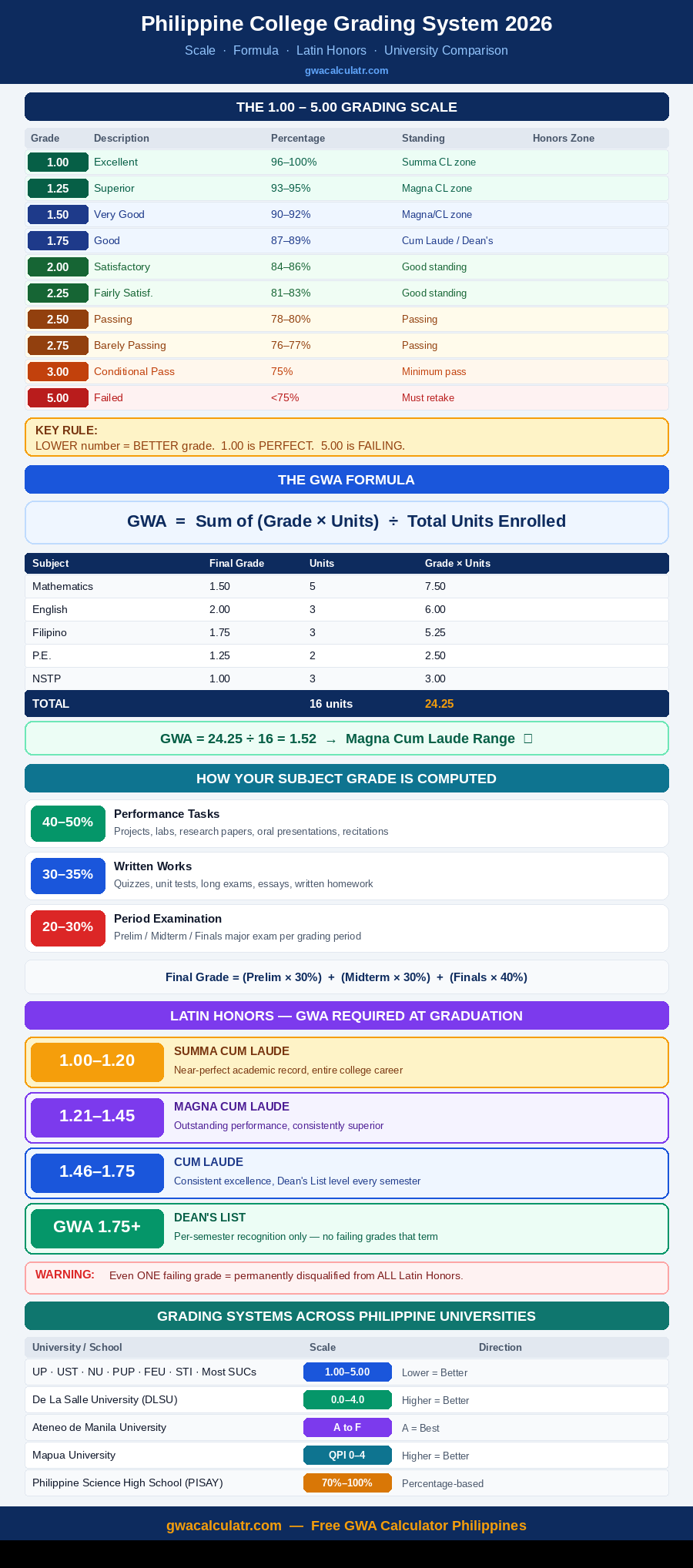
| Grade | Description | Percentage | GPA Equivalent | Standing |
|---|---|---|---|---|
| 1.00 | Excellent | 96–100% | 4.00 | Summa Cum Laude |
| 1.25 | Superior | 93–95% | 3.75 | Magna Cum Laude |
| 1.50 | Very Good | 90–92% | 3.50 | Magna / Cum Laude |
| 1.75 | Good | 87–89% | 3.25 | Cum Laude / Dean’s List |
| 2.00 | Satisfactory | 84–86% | 3.00 | Good standing |
| 2.25 | Fairly Satisfactory | 81–83% | 2.75 | Good standing |
| 2.50 | Passing | 78–80% | 2.50 | Passing |
| 2.75 | Barely Passing | 76–77% | 2.25 | Passing |
| 3.00 | Conditional Pass | 75% | 2.00 | Minimum pass |
| 5.00 | Failed | Below 75% | 0.00 | Must retake |
This scale is used by the University of the Philippines, the University of Santo Tomas, National University, PUP, most state universities and colleges, and the vast majority of private colleges across the Philippines.Students frequently ask what specific grades on this scale mean in real terms. A grade of 2.25, for example, represents Fairly Satisfactory performance at 81 to 83 percent passing and in good standing, but below the threshold required for Dean’s List recognition or most government scholarships
How Grades Are Computed Inside Each Subject
Your final grade in each subject is not a single exam result. It is a weighted combination of three distinct types of academic output, assessed across the entire semester.
Written Works (30 to 35 percent)
Written Works includes quizzes, unit tests, long examinations, essays, written reports, and homework. These are assessed throughout the semester and reflect consistent knowledge retention. Missing even minor quizzes has a compounding negative effect on this component because each missed assessment records as a zero.
Performance Tasks (40 to 50 percent)
Performance Tasks is typically the largest single component and includes projects, research papers, laboratory experiments, oral presentations, group outputs, recitations, and demonstrations. Because this component carries the heaviest weight, consistently strong output on Performance Tasks is the most reliable path to a strong final grade.
Major Period Examination (20 to 30 percent)
Each grading period Prelim, Midterm, and Finals ends with a major examination. Despite being the most high-stakes single assessment, the period examination is usually not the largest component. Strong consistent performance in Written Works and Performance Tasks provides a solid foundation even before the examination.
How the Three Periods Combine
Most Philippine universities use the following weighting across the three grading periods:
Final Subject Grade = (Prelim Grade × 30%) + (Midterm Grade × 30%) + (Finals Grade × 40%)
This formula gives the Finals period the heaviest weight of the three meaning a student who peaks in performance toward the end of the semester has the best mathematical position for a strong final grade.
Note that some universities and some programs use different weightings 25-25-50, 33-33-34, or other distributions. Always check the course syllabus on the first day of class for the exact grading breakdown your professor will use.
How GWA Is Computed The Formula
Once you have final grades in all your subjects, your GWA is computed using the weighted average formula:
GWA = Sum of (Grade × Units per subject) ÷ Total Units Enrolled
Here is a complete semester computation:
| Subject | Final Grade | Units | Grade × Units |
|---|---|---|---|
| Professional subject | 1.75 | 5 | 8.75 |
| Science subject | 2.00 | 4 | 8.00 |
| Communication Arts | 1.50 | 3 | 4.50 |
| Filipino | 2.25 | 3 | 6.75 |
| Physical Education | 1.00 | 2 | 2.00 |
| NSTP | 1.25 | 3 | 3.75 |
| Total | 20 units | 33.75 |
GWA = 33.75 ÷ 20 = 1.69
This student earned a semestral GWA of 1.69 in the Cum Laude range and above the Dean’s List threshold of 1.75.
Grading Systems at Different Philippine Universities
The Philippine Commission on Higher Education (CHED) does not mandate a single uniform grading system for all universities. Institutions are free to develop their own grading frameworks as long as they maintain academic quality and transparency. This is why grading systems vary meaningfully across Philippine universities.
Standard 1.00 to 5.00 Scale (Most Universities)
Used by UP, UST, NU, PUP, FEU, UE, CEU, AUF, STI, most state universities and colleges, and the vast majority of private colleges. The descending scale where 1.00 is best and 5.00 is failing. Minimum passing grade: 3.00.
DLSU Ascending 0.0 to 4.0 Scale
De La Salle University uses an ascending scale modeled on the American GPA system. Grade 4.0 is the highest, grade 0.0 is failing. Minimum passing grade: 1.0. DLSU uses this system to facilitate international credit recognition and student exchange. A DLSU grade of 3.5 is equivalent in performance level to approximately a 1.50 on the standard Philippine scale.
Ateneo de Manila Letter Grade System
Ateneo de Manila University uses letter grades (A, B, C, D, F) with grade point values assigned to each level. A grades correspond to 92 to 100 percent performance. The Ateneo GPA is computed from these letter grade values on an ascending scale.
Mapua QPI System
Mapua University uses a Quality Point Index (QPI) on an ascending scale higher QPI means better performance. This is the system that causes most confusion for students and employers comparing Mapua grades with grades from standard-scale universities.
PISAY Percentage System
Philippine Science High School uses direct percentage grades from 70 to 100 with 75 as the minimum passing threshold. All assessments are expressed as percentages without conversion to a separate numerical scale.
Special Grade Statuses in the Philippine System
Beyond the numerical grades, Philippine universities use several important grade notations:
INC (Incomplete) Given when a student could not complete all course requirements by the semester’s end but had a passing class standing. Not computed in GWA. Must be resolved within the allowed period typically one academic year or it automatically becomes 5.00.
DRP or W (Dropped / Withdrawn) Subject officially dropped before the deadline. Not computed in GWA. Does not count as a failing grade but affects total enrolled units.
FDA (Failure Due to Absences) Failing grade for exceeding the maximum absence limit (typically 20 percent of class hours). Computed exactly like 5.00 in GWA.
NC (No Credit) Pass/fail subject. Not included in GWA computation.For a complete reference covering every grade notation what each one means for your GWA, your scholarship, and your Latin honor eligibility our full guide on grades in college Philippines covers all of it in one place.
How the Philippine Grading System Determines Academic Recognition
Dean’s List Semester by Semester
Dean’s List recognition is awarded each semester to students who achieve a semestral GWA of 1.75 or better with no failing grades and no incomplete grades. It is semester-specific a student earns it or does not earn it term by term based solely on that semester’s performance.For the complete breakdown of Dean’s List GWA requirements at every major university including the stricter UST condition, UP’s College Scholar system, and the difference between Dean’s Lister and President’s Lister see our dedicated guide on Dean’s Lister requirements Philippines
Latin Honors Across the Entire College Career
Latin honors are determined at graduation from the cumulative GWA the weighted average of every grade across every semester from first year to final year.
| Latin Honor | Cumulative GWA | Additional Condition |
|---|---|---|
| Summa Cum Laude | Approx. 1.00–1.20 | Zero failing grades, no unresolved INC |
| Magna Cum Laude | Approx. 1.21–1.45 | Zero failing grades, no unresolved INC |
| Cum Laude | Approx. 1.46–1.75 | Zero failing grades, no unresolved INC |
The zero-failing-grade condition is absolute. A student who failed one subject in first year, recovered completely, and maintained a cumulative GWA of 1.70 in all subsequent semesters will still be disqualified from all Latin honors because of that single early failing grade.
How Philippine Grading Compares to International Systems
| System | Best Grade | Failing | Min Pass | Direction | Used In |
|---|---|---|---|---|---|
| Philippine GWA | 1.00 | 5.00 | 3.00 | Lower = better | Philippines (most) |
| US GPA | 4.00 | 0.00 | 2.00 | Higher = better | USA, internationally |
| UK Classification | First Class (70%+) | Fail | Pass | Higher = better | United Kingdom |
| Australian GPA | 7.00 | 0.00 | Varies | Higher = better | Australia |
When expressing Philippine grades for international applications, Filipino students must always clarify the direction of the scale. A GWA of 1.75 means excellent not near-failing. The conversion formula GPA ≈ 5.0 minus GWA gives a quick approximation: 1.75 GWA converts to approximately GPA 3.25.
Frequently Asked Questions About the Philippine College Grading System
What is the grading system in Philippine college?
Most Philippine colleges use a numerical grading system on a 1.00 to 5.00 scale where 1.00 is the highest grade (Excellent) and 5.00 is failing. The minimum passing grade is 3.00, corresponding to 75 percent performance. Overall academic performance is measured by GWA (General Weighted Average), computed by multiplying each subject’s grade by its credit units and dividing by total units enrolled.
Does CHED have an official standard grading system for all Philippine colleges?
CHED does not mandate a single uniform grading system across all Philippine higher education institutions. Most universities independently adopt the standard 1.00 to 5.00 scale, but some notably DLSU and FEU-East Asia College — use ascending 0.0 to 4.0 scales modeled on the American GPA system. CHED requires that all grading systems be fair, transparent, and aligned with the Philippine Qualifications Framework.
What is the difference between GWA and GPA in the Philippine grading system?
GWA (General Weighted Average) is the Philippine system where grades on a descending 1.00 to 5.00 scale are weighted by credit units. GPA (Grade Point Average) is the American system where grades on an ascending 0.0 to 4.0 scale are weighted by credit hours. Both compute a weighted average of academic performance, but they run in opposite directions. A Philippine GWA of 1.00 is equivalent in achievement to an American GPA of 4.00 both represent the highest possible performance on their respective scales.
Why does the Philippine grading system run backwards compared to GPA?
The Philippine grading system’s descending scale is a legacy of the Spanish and American colonial educational frameworks adopted during the Philippines’ formative period as a modern nation, later developed into the current standardized system. The descending 1.00 to 5.00 scale became the convention for most Philippine public universities, which then influenced private institutions across the country. CHED has not standardized the direction, which is why some universities (DLSU, Ateneo) now use ascending scales aligned with global convention.
What is the minimum GWA required to graduate from a Philippine college?
The standard minimum cumulative GWA for graduation at most Philippine colleges is 3.00 on the 1.00 to 5.00 scale — the same as the minimum passing grade per subject. A student whose cumulative GWA falls above 3.00 numerically (meaning worse performance) is typically in academic difficulty and may face academic probation or program dismissal depending on institutional policies.